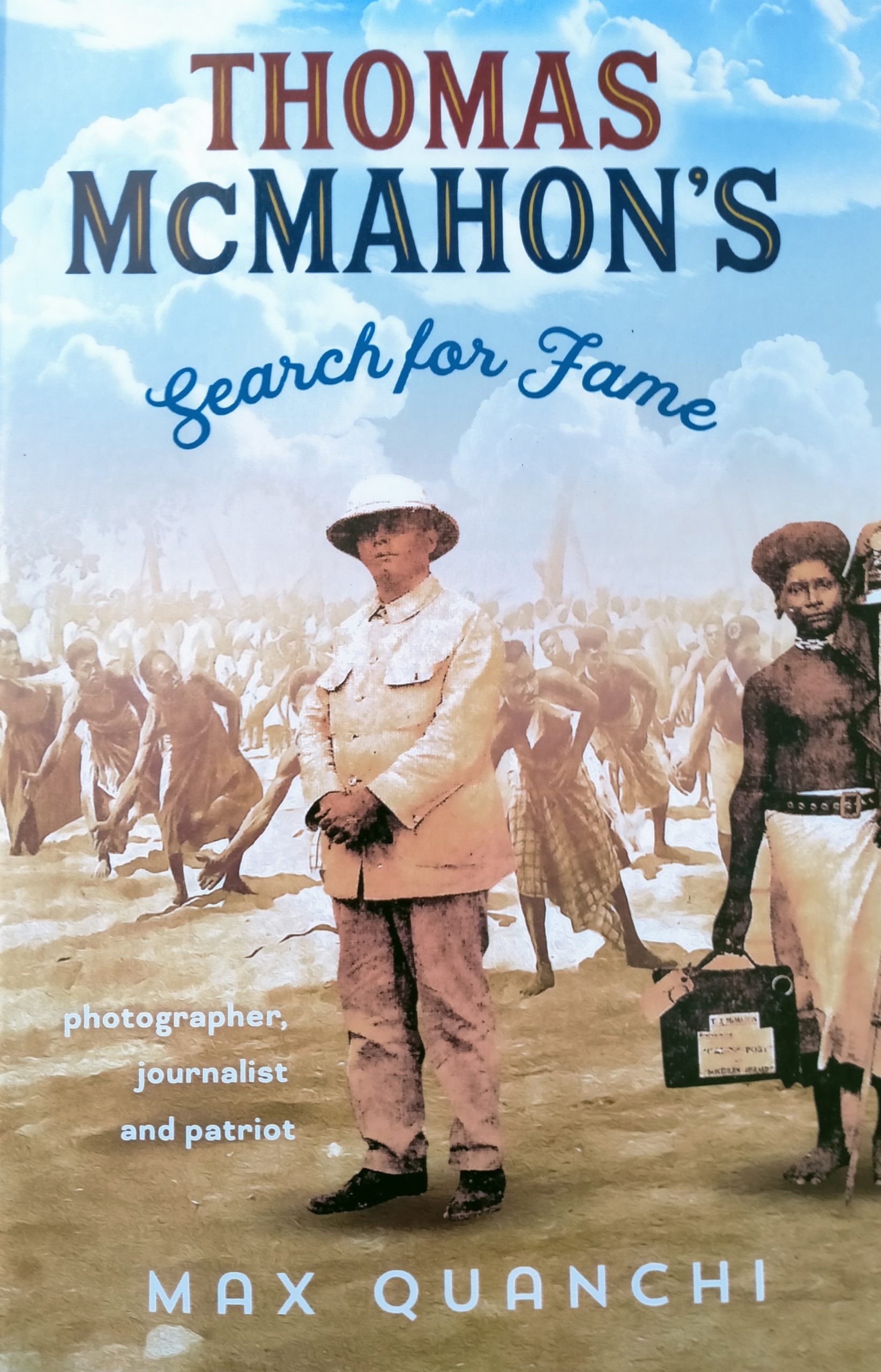
Thomas McMahon’s Search for Fame
Allow me to speak about a Thomas McMahon’s life whose search for fame was to take over the latter part of his life.
Max Quanchi,, a Moem graduate (1966-7) in PNG, wrote of Thomas McMahon’s life in a book called “Thomas McMahon’s Search for Fame”
In 1864, Thomas was born at Mt Abundance west of Rome. He died in 1933 in New Farm, Brisbane.
Between 1915 and 1922, with self-funded means, he travelled to eleven Pacific Islands. Photography, in the early days, meant that a sizeable quantity of equipment was needed to take his still pictures. Camera plates, chemicals and development equipment made up Tom’s package. This he did as the world in the Pacific changed dramatically with the German removal and the new inhabitants being Australia, New Zealand, Japan and the USA taking over the vacant space, Britain held onto its holdings and so did France.
Max Quanchi describes Tom McMahon’s efforts as a photographer, journalist, and a patriot. This person comes to life with the efforts of Trobe.
In 1915 in September, he visits Papua and German New Guinea. This is a career change from a school tutor to a photographer in his 51year. Can you remember your first glimpses of PNG as you stepped off the plane in 34 degrees. Or the seeing a police man in Port Moresby directing traffic from a central plinth in the roadway?
Thomas McMahon’s visit included Port Moresby, Samari, Milne Bay and Rabaul. The newspapers who carried his reports included The Papuan, the Northern Herald, and The Cairns Post. This is the first installment of Papuan life. The photographic evidence may be found in these newspapers. Full page formats over an 8th month period appeared regularly.
In Brisbane, the Queenslander opened with sisal, hemp, tobacco, rubber and coconut growing.
Tom’s photographs filled many of the newspapers between Cairns and Melbourne. He gave notes to each picture and they graced each publication, as well as at London and many pictorials in the USA.
Why did he do it?
He made each photograph a celebration of British Australian enterprises. Papua and German New Guinea were covered well including Rabaul after British annexation. Soldiers captured the Bitapaka wireless station in 1915.
In 1917 during his second visit, Tom spoke highly of the new (ex-German) enterprises. He had much to say regarding the promoting of local industries and the manpower that was willing to work.
“He was there” was his constant reply.
In his first trip to the Islands to Papua and German New Guinea, he posed with local dignities. At one stage, he received a letter of introduction from Billy Hughes PM.
He addressed local community groups (RedCross, Kodak Gallery, various Royal Geological Societies etc) while his photographs were shown locally and in international publications. At least 880 photographs were produced in the 1915-1922 period.
As well as Papua and German New Guinea, he visited the Solomons, Vanuatu, Fiji, Nauru, Banaba, Lord Howe Island, Kiribati and the Marshall Islands.
Thomas was well recognized in the Pacific, Queensland, Torres Strait and Northern Territory in pictorial form.
“I was there” when boosting Australian trade and commercial potential available in the Pacific.
Max Quanchi has taken Thomas McMahon’s legacy to the world. Not a book for everyone, but one that is replete with time honoured coverage of Tom’s works.
Published in Australia by Sid Harta Books & Print Pty Ltd. Glen Waverley, Vic 3150.
Terry Edwinsmith