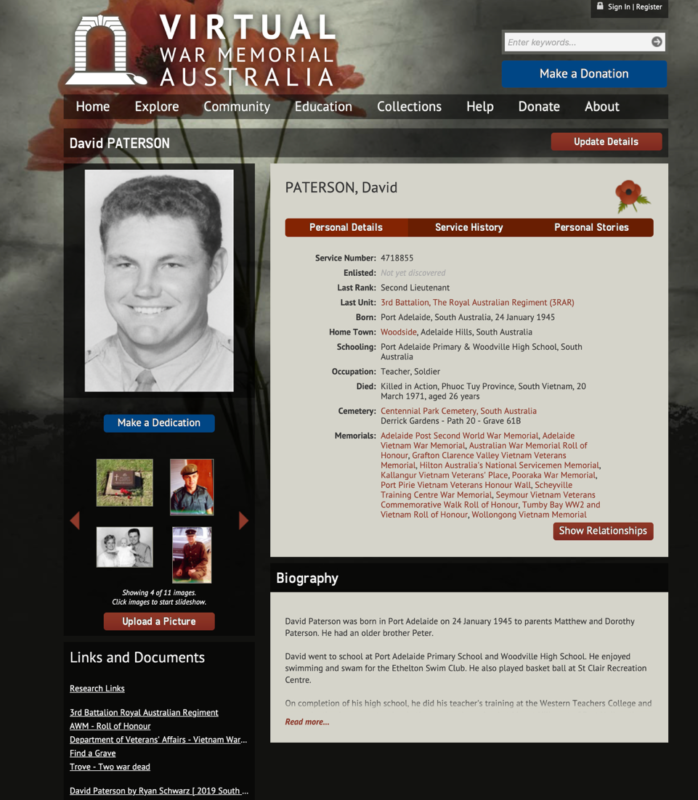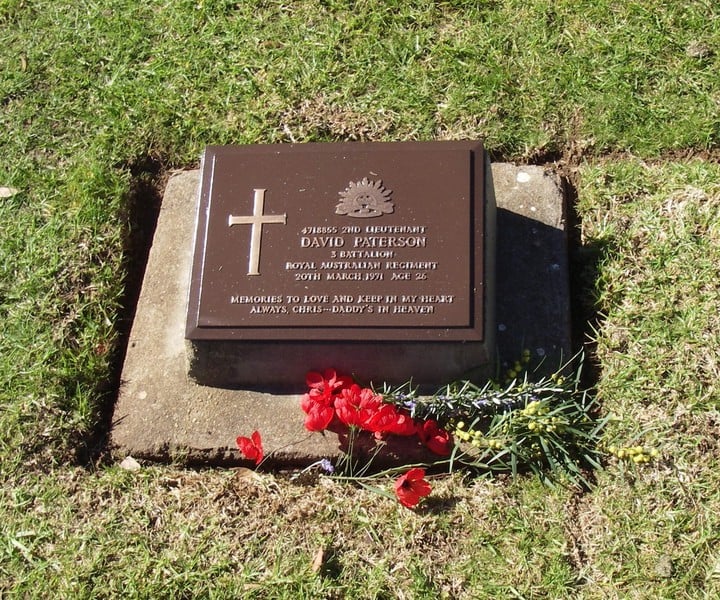
David Paterson was born in Port Adelaide on the 24th of January 1945 to Mathew and Dorothy Paterson. He had an older brother, Peter. David went to school at Port Adelaide Primary school and then to Woodville High School. He enjoyed swimming, being a member of the Ethelton Swim Club; and basketball, playing at the St Claire recreational centre. After graduating from school, David immediately began teacher training at the Western Teachers’ College. A few days before his 20th birthday, he graduated from college and was accepted into a one-teacher school in Mount Hill on the 11th January 1965. Whilst there he continued swimming and basketball and also took up football for his local football club. The posting at Mount Hill lasted for two years. During this time he began travelling to Cleve and continued studying. It was because of this study that he had his National Service postponed twice. He loved his teaching and the students adored him. A fellow veteran after returning from Vietnam went back to Mount Hill to interview David’s students and found, “David is remembered with great fondness who enriched and valued their communities…It was very clear to me that David had left a lasting impression on these students”. In 1966, David met his future wife Christine at the Ethelton swimming club.
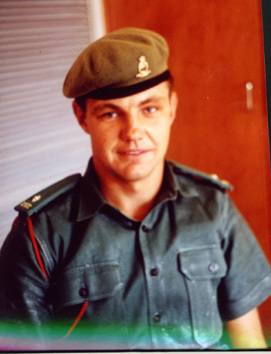
In 1967 he was enlisted into the Australian Army where he was selected to participate in officer training. This training was the selection of the best of the very best and a gruelling experience. A fellow platoon commander stated, “During intensive training, [David] proved to be an outstanding leader and a highly competent commander, and his boys loved and respected him immensely.” It took 12 months to finish officer training, but after completion he was posted to the Pacific Islands Regiment. This post took David to Papua New Guinea where he played a crucial role in educating local soldiers. On the 4th October 1969 he married Christine, his long-time sweetheart. After returning from overseas, David volunteered to continue service in the Army and was transferred to the 3RAR based in Woodside. It was in Woodside that his daughter Sarah was born on 12th September 1970. David was posted to the 8th Platoon of Charlie Company 3RAR where he travelled with the battalion to South Vietnam. He arrived there on the 12th February 1971.
David became the second lieutenant of 8th Platoon. During this time he was respected as one of the best mappers in the entire Battalion. His ability to pinpoint locations was crucial in destroying the enemy and keeping artillery away from our allies. In the thick jungles of Vietnam, this skill was vital. David was also known for his massive stature, standing over six foot, four inches tall. He had ginormous feet which had grown to shoe size 18! His mates made the joke that with him nothing would happen if he was shot because his whopping feet would keep him standing. On his very first patrol, David was struck down with heat stroke. He could not take in any water and it took him a few days to recover.
During this time, a battalion was forced to pull out of the area, leaving just two battalions. David then took part in a patrol that ended his life. He was with fellow soldiers Allan Gould and Martin Macanas on this ill-fated patrol. Allan was badly injured in the ambush and he thought that he wouldn’t make it. Martin lost his index finger whilst holding his gun to his
chest. A bullet obliterated the finger that was holding the trigger, but it nevertheless shielded Martin’s chest. Allan kindly offered his first-hand experience of the contact as follows:
“We had split the platoon with Hoppy (Sgt Claude Hoppe) taking the other half and the Skipper (Lt Dave Paterson) with us. We heard what we thought were woodchoppers and knowing it was a No No Zone we figured they were VC.
The Skipper formed us up with the gun on the high side, him in the middle and me to the right of him slightly forward (as I was the forward scout) trying to make out what was ahead.
We fired a couple of M 79 rounds and moved forward and then all hell broke loose. I got hit by an RPG (Rocket Propelled Grenade) and went down in a screaming heap. Everyone hit the deck. The Skipper rolled over to me and told me I was OK. When I saw him next he was dead.
The enemy we later found out was a reinforced NVA company with a heavy weapon section including a 12.7 mm MG (Machine Gun) dug in, in a reversed U so I was in the middle of the killing ground with the section gun firing over me for protection as the NVA were attempting to get to me.
All I remember after seeing the explosion and the Skipper dead after he tried to reassure me was rolling on to my left side (I was hit in the lung and it was sucking).They told me later we were out there for 6 hours before the cav came in and picked me up to lift me to the LZ (Landing Zone). For that whole time the guys covered me and the Skipper with the gun and their own weapons and I was also told our section commander tried to pull me back but was taking fire from the 12.7 and could not do it. That’s about all I remember, apart from feeling really cold on the chopper and waking up next to a NVA in the next bed.”
During the ambush, with David lying mortally wounded under intensive fire, a handful of his soldiers courageously tried to pull him out of the hot zone. Seeing that these men would inevitably become casualties themselves if they tried to pull them out, David ordered them to leave him and escape. It was an enormous act of selflessness and courage. He died trying to save his brothers. The rest of the patrol escaped by lying flat on the ground pretending they were dead. They had ran out of ammo and after a while the VC believed they had all been shot. In small groups they slowly crawled out of the bushes. RAAF helicopter gunships were called in to support the patrol and Private Officer Betts, a co-pilot, was terribly wounded and later died at a Fire Support Base. Another soldier from C Company records his final view of David Paterson: “The last view of David Paterson that I had was his body laying face down in the back of an APC with the sole of one boot flapping…His boots had to be a special order. His had worn out and replacement boots had not arrived; he had one boot held together with rubber bands.”
David had a lasting impact on every single digger he encountered. His men described him as an ‘exceptional human being…fair, sensible and enormously popular. He could have spoken in front of anyone, from a cleaner to a King’
As Banjo Paterson said “We have through what you boys have done, a history of our own”
Lest We Forget, Lieutenant David Paterson.
by Bob Woods October 2014